Tag Archive for: Patents

In an era where ideas hit the internet before breakfast through preprints like GitHub commits, Discord forum dumps, LinkedIn “build in public” threads, and even leaked pitch decks, your idea might already be public domain before you file your first provisional. Patent examiners are finding these breadcrumbs with AI-powered search engines that never sleep.

Welcome to the new landscape of patentability: one where your first task isn’t claim drafting, but a digital excavation.

Why Do Founders Keep Falling into the Prior Art Trap?

Most first-time innovators think “prior art” means dusty old patents filed by big corporations. In reality, prior art is everything the internet has touched. That includes:

      a) academic preprints

      b) GitHub repositories

      c) product demo videos

      d) YouTube explainers

      e) Kickstarter campaigns

      f) conference abstracts 

      g) university archives

      h) whitepapers

      i) internal documentation leaks

Which means, legally, your “brand new” invention may already be publicly accessible, even if it’s buried three clicks deep in an unindexed PDF uploaded by a PhD student at 3 AM.

Thus, it results in founders unknowingly destroying their own novelty long before drafting claims. The invention was brilliant, but it had already been disclosed somewhere, by someone, or even themselves.

Modern Prior Art Is Everywhere

Here’s the truth that experienced patent lawyers and investors already know: good innovators don’t just invent; they verify.

The strength of your patent is directly proportional to the depth of your prior-art search. If you skip that step, filing a patent becomes a shot in the dark and novelty is lost the moment examiners find a single line in a forgotten repository.

The Three Prior Art Traps Innovators Shouldn’t Underestimate

The Digital Footprint Trap

From your hackathon repo, to that half baked snippet on Stack Overflow, to even your designer’s Figma prototype uploaded on a community forum, anything that touches the open internet, even briefly, can be indexed, archived, and ultimately cited by patent examiners. Hence, if it’s online, assume a patent officer can find it faster than you can delete it.

The Academic & Preprint Trap

Today preprint platforms like arXiv, SSRN, medRxiv, PubMed Preprints, and university repositories are crawled by WIPO, EPO, and USPTO tools. And as a researcher, if you have already explained the architecture, the workflow, the algorithm, or even the motivation behind your idea, your novelty may already be dead. As academia moves faster than the patent system. And it counts.

The Self-Disclosure Trap (The Founder’s Own Mistake)

As we said before in our previous articles, if you go through pitch decks shown at demo days, accelerator websites, Proof-of-Concept videos, LinkedIn “launch soon” posts, conference posters or even early customer showcases, without securing yourselves a patent application date, then you have already step foot in the self-disclosure trap. In strict jurisdictions like Europe, your own disclosure is just as fatal as your competitor’s. In short, marketing too early is the #1 way to lose a patent you deserve.

What Good Prior-Art Due Diligence Actually Looks Like

A real novelty check in 2026 goes far beyond Google Patents. A founder-friendly, investor-safe prior-art search includes:

      a) full sweep of global patent databases (WIPO, USPTO, EPO, KIPRIS)

      b) non-patent literature search (IEEE, ACM, PubMed, arXiv)

      c) GitHub and code repository scans

      d) Detailed analysis of competitor products + documentation

      e) keyword + inventor-name analysis

      f) and always: filing a provisional before you talk to the world

Common Founder Mistakes That Kill Patents (Fast)

      a) assuming “nobody published this” without checking

      b) presenting at Demo Day before filing

      c) ignoring non-patent literature

      d) building on open-source without reading the license

      e) thinking cosmetic changes = novelty

      f) confusing “nobody knows this” with “nobody has disclosed this”

Patent examiners don’t care if something was obscure and only whether it existed.

Why This Matters Even More in 2026

Three trends collided to make novelty incredibly fragile:

      1. Preprint culture exploded – researchers upload before peer review.

      2. AI search tools can detect obscure prior art across languages.

      3. Global patent filings are at an all-time high (WIPO 2024 Report).

      4. Startups are shipping MVPs earlier for traction, creating accidental disclosure.

      5. Tech media leaks everything, often before companies can even file.

      6. Patent offices have tightened novelty thresholds, especially for AI-related inventions.

The window between “idea born” → “world knows” → “novelty destroyed” is now measured in days, not months.

So How to Stay Safe? Here’s what you can do:

      Step 1: Run a novelty search before drafting claims.

      Step 2: File a provisional early – perfection can come later.

      Step 3: Avoid any public disclosure until you have a filing date.

      Step 4: Document the inventive process (helps prove inventorship).

      Step 5: Use AI tools + human experts for prior-art analysis.

      Step 6: Keep updating your patent family as your product evolves.

This isn’t just legal hygiene, it’s strategic defence.

Takeway:

In a world of instant publishing and global visibility, your biggest threat isn’t a competitor; it’s unknown prior art already floating somewhere online.

So, before you file, pitch, or post… ask the most important question in modern innovation: “Is my idea already out there?”


Interested in innovation, technology and patent protection? I have a lot of insights into how technology protection works from my years in the field, and I’ll be sharing more of them on this newsletter.

Connect with me if you are thinking about IP Protection!

Introduction

Today, in the field of patents, Artificial Intelligence (AI) is emerging as a powerful ally. By supporting inventors, IP professionals, and patent attorneys in conducting searches, managing prosecution, and streamlining the drafting process; AI is giving them time to focus on more strategic aspects of innovation. In fact, the 2024 survey conducted by FICPI’s Practice Management Committee (PMC) found that among those using AI tools for work, 38% use it for patent searches, 19% (approximately) for patent drafting, and 24% use AI for analyzing prior art.

However, AI is still developing and far from being the flawless Jarvis we imagine it to be. Its outputs, while efficient, must be approached with caution, especially concerning accuracy, confidentiality, and compliance with laws.

So, if you are considering integrating AI into your patent process, here are three important things to keep in mind. 

1. How Can AI Be Useful?

AI has changed how things are prepared, reviewed, and filed. Today, you can use AI for more than one stage of your patent application, such as:  

  • Conducting Patent searches – AI can narrow down the scope of your prior art search criteria and even categorize existing patents based on grounds set by you.
  • Drafting Patent Applications – AI may help you provide quick drafts within minutes, reduce efforts and hours, save money, reduce clerical errors, and even suggest broader claims (providing, of course, that the AI database supports higher level tasks). 
  • Generating Patent Drawings – AI can help to generate drawings of your invention, either based on images or even text, and even aid in labeling them
  • Plus, AI can even help you analyze or review patent applications.

However, these benefits are only realized if you use it in the right way, such as:

  • Providing a complete invention disclosure – Think of AI as a person with no prior knowledge about your invention. To allow an AI to process your novel invention,, you will need to define all parts of it (background technology, unique features, competitive advantages etc.) in detail.
  • Reviewing the AI output – Even if we input all the relevant information, the AI may not necessarily give us the desired or required output. You will need to strictly review the output before finalizing your patent draft.  


2. How Using AI Is Risky

While AI may be beneficial, it is not foolproof and comes with certain risks: 

  • Confidentiality risks: Using AI tools without strong data protection, especially cloud-based AI tools, comes with the inherent risks related to privacy and confidentiality.  The information or prompts that you are providing the AI get stored on a third-party server, which, if released by mistake or used in training an AI model, can make you lose the novelty aspect of your patent. 
  • AI hallucinations: Sometimes AI tools can generate data, citations, or facts that may seem to be true, but are actually false. Such mistakes are called AI hallucinations. These mistakes, if not addressed, can be fatal during patent prosecution . 
  • Quality detection issues: Today, AI tools are being used so widely that people can decide whether a text is AI-generated or not from a small sample. So even if the content is accurate, certain phrases or patterns may reveal its AI origin, which could affect perceptions of the quality or originality of your draft.


3. How to Choose the Right AI

Not every “AI-powered” tool understands patents. Many simply generate text, not structured applications. Thus, it’s necessary to look out for certain essential elements when selecting an AI tool for your patent process.

While most AI tools, especially for patents, are Generative AI-based on Large Language Models (LLM), a good patent AI tool is the one that:

  • Maintains confidentiality – Since you are providing the information about your patent, the  AI tool you pick must have strong encryption with no data retention policy. Local AI tools as opposed to cloud-based AI tools are much better suited to this. Thus, it is necessary to know about the privacy policy, terms of use, and data handling practices of such AI tools.
  • Consider the Prior Art and have access to a database – If an AI tool has access to various patent databases not only of your jurisdiction but also of other jurisdictions as well, then this will not only help you in your prior art search but also save your time in drafting patent applications. A larger database  can better process the existing prior art from  different jurisdictions. 
  • Understand the legal compliances: Any AI tool can translate or format your invention into claims by simple commands. But a good AI tool should have the capability of understanding your invention in context  with the existing law and provide drafts accordingly, such as the correct format, correct size, correct number of claims, and so on.
  • Can customize and is flexible – Each patent draft is unique, and may be different based on your invention or jurisdiction (where you intend to file). Thus, an AI tool that can adapt your drafts into different templates in its output is more desirable.
  • Explains the Drafts created – Don’t choose an AI that just drafts instantly without showing how claims were structured or which prior art was considered. An AI tool that offers transparency by explaining how it builds claims or maps concepts not only helps you to review it more effectively, but also lets you understand your own invention more correctly.
  • Provides Drawings: If an AI tool, apart from just drafting a patent, can also provide aid in drafting drawings, then it is a cherry on the cake and would save a lot of time and effort in the preparation of your patent application.
  • Aligns with your budget – AI is the future, but it’s not compulsory. Given the stringent requirements for AI-based patent drafting, careful curation of the tools you use are required. Under such circumstances, make sure that the AI tool you use aligns with your budget. 

The Key Takeaway

What must be remembered is that AI is here to assist you,  not to do the entire task. Even if you select the best AI for your patent search and drafting, it does not mean that it won’t make mistakes.

When using AI, think of the inventor as a teacher, who needs to guide the AI so that it can understand and explain the inventions as we know and want to. While certain AI tools have better capabilities and understanding than others and can provide the desired results with less effort, it’s ultimately up to the inventor to decide if it’s worth spending time and resources guiding the AI and entrusting his confidential knowledge to it.


Interested in innovation, technology and patent protection? I have a lot of insights into how technology protection works from my years in the field, and I’ll be sharing more of them on this newsletter.

Connect with me if you are thinking about IP Protection!

Six months ago, a founder came to us in a panic.

Her startup had just launched a new health-tech prototype. She had pitched it at a demo day, received overwhelming interest from two major investors, and suddenly found herself racing against time.

“We filed a provisional patent right before the pitch,” she said. “But now we’re not sure what to do next. Can we change it? Is it even valid? Are we protected?

This is where many startups and innovators find themselves-believing a provisional patent is a silver bullet, which is quick, cheap, and protective. In truth, a provisional patent is only as useful as the strategy behind it. Used right, it’s a brilliant head start. Used wrong, it’s a false safety net.

Here’s what I’ve learned from guiding dozens of founders through this process:

Why Provisional Patents Became So Popular

Provisional patent applications were introduced to give inventors flexibility. Instead of spending time and resources drafting a full specification, you could file a simpler document, establish a priority date, and then come back with a complete application within 12 months.

In theory, that sounds ideal; especially for early-stage ideas. It gives you room to test, pivot, and raise funds, all while keeping your innovation protected from being scooped.

But in practice? The way provisional patents are used often falls short of what they promise.

The Most Common Misuse: Filing and Forgetting

The founder who came to us had done what many others do: she filed a barebones provisional application using an online form builder, added a few sketches and descriptions, and assumed that meant her invention was now protected.

It wasn’t.

What she didn’t realize was that a provisional patent doesn’t grant you any enforceable rights. It doesn’t get examined. It doesn’t get published. And it won’t protect anything that wasn’t clearly described inside it. If your description is vague, your coverage is vague. If you pivot your product after filing, and don’t update the filing, your new invention might not be covered at all.

In other words, a poorly drafted provisional can give the illusion of protection, while leaving critical innovations exposed.

Where a Provisional Patent Shines

Now, that doesn’t mean provisionals are useless. In fact, they can be incredibly powerful when used with intention.

They are most helpful in fast-moving scenarios where disclosure is inevitable. Think startup pitches, product demos, launch campaigns, or investor due diligence. In those moments, you need to lock in your priority date before you reveal anything publicly.

Provisionals allow you to say: this is the point in time when I claimed ownership of this invention. That claim is your priority date, which protects you against someone else filing the same invention later. It gives you time to develop, validate, and refine your invention, while holding your place in line. But again, that only works if what you filed was detailed, specific, and accurate.

How to Use a Provisional Patent the Right Way

The key to making a provisional patent actually useful is to treat it like a full filing, having a little flexibility. That means:

  • Describe your invention in as much detail as you can. Don’t assume you’ll “add it later.”
  • Include any variations or alternative configurations that you might explore during the year.
  • Document how it works, why it works, and what makes it novel. Think like a technical storyteller.

In short, don’t treat the provisional as a placeholder, treat it as a first draft of your real protection.

Then, use the 12-month window wisely. Reassess your product direction. Gather user feedback. Build a business case. And when you’re ready, file your complete (non-provisional) patent with stronger claims, refined technical details, and a clearer commercial strategy.

What Happens If You Wait Too Long

The founder who came to us realized this just in time. She was in month ten of her provisional window, and hadn’t started preparing her full application. Worse, her product had changed significantly since the first filing.

Had she waited longer, she might’ve lost the chance to protect her updated invention entirely. The deadline would have passed, and any new version of the product would need to be filed as a new application, with a new priority date.

That’s a huge risk in competitive markets. Filing a complete patent too late could mean someone else beats you to the office with a similar idea and you lose out, even if you were first to build. That’s why we always advise founders: mark the 12-month expiry the day you file your provisional. Treat it like a countdown. And plan your complete filing proactively, not reactively.

What You Really Gain from Filing Provisional First

If done right, a provisional patent gives you:

  • Speed: because you can file faster than a full patent.
  • Security: because you lock in your ownership before revealing anything.
  • Strategy: because you gain a year to refine your tech and align your patent to your business model.

It’s especially useful for:

  • Product teams launching in public
  • Startups pitching to investors
  • Companies with early-stage prototypes
  • Innovators still finalizing features or UI

But the filing is only the beginning. The real value is in how you use that year.

So, Is It Really Helpful?

Yes, if you file it intentionally, and follow it up strategically.

No, if you treat it like a shortcut, and delay important decisions.

In the end, a provisional patent is not a substitute for a full application. It’s a tool for protecting your innovation before you’re ready to commit to the full process. Like any tool, it works best when it’s used with clarity and care.

So before you file one, ask yourself:

  • Am I doing this just to “check the box” before launch?
  • Or am I using this window to prepare for a stronger, smarter patent filing?

If it’s the latter, you’re on the right path.


Interested in innovation, technology and patent protection? I have a lot of insights into how technology protection works from my years in the field, and I’ll be sharing more of them on this newsletter.

Connect with me if you are thinking about IP Protection!

Do you know who actually owns a patent?

Many people assume that the inventor automatically owns the rights, but that’s not always the case. There is a significant difference between the inventor, applicant, and assignee, and understanding these roles is crucial for securing and managing intellectual property.

A Real-Life Confusion in Patent Ownership

In my eight years of patent practice, I encountered a unique situation today. A person from a company (let’s call him X) reached out, explaining that he had included Person Y (from an external agency) as an inventor in a patent application. However, Person Y refused to assign rights to the company, didn’t want any commercial interest in the patent, and didn’t even want to be recognized as an inventor.

At first, this seemed unusual, but after discussing it further, we realized the issue wasn’t about ownership—it was about awareness. Person Y was simply unaware of the distinctions between an inventor, an applicant, and an assignee.

Breaking It Down: Inventor vs. Applicant vs. Assignee

To clear up confusion, here’s a simple breakdown of these three roles:

🔹 Inventor – The person who conceives the invention. They must be named in the application, but being an inventor does not automatically mean they own the patent.

🔹 Applicant – The individual or entity who files the patent. This can be the inventor, their employer, or any entity they assign their rights to. The applicant usually owns the patent unless an agreement states otherwise.

🔹 Assignee – The person or entity to whom patent rights are transferred. An inventor may be required to assign rights to their employer or another party, depending on contracts, company policies, or agreements.

In Person Y’s case, they misunderstood their role. They thought being listed as an inventor meant they had legal and financial obligations, which wasn’t necessarily true.

Key Takeaways: Avoiding Ownership Confusion

✔️ Inventors create the invention, but don’t always own it.

✔️ Applicants file and own the patent—this can be an individual, company, or other entity.

✔️ Assignees are those who receive patent rights through a formal transfer.

✔️ Employment agreements often determine whether an employee-inventor must assign rights to their company.

Understanding these distinctions ensures smooth IP management and avoids disputes. Before filing a patent, always clarify who owns what!

Have you ever faced a patent ownership dilemma? Let’s discuss 🙂

One of the biggest concerns innovators face when working on a patent project is budgeting. The costs can seem overwhelming, leading many inventors to delay or even abandon the process.

While securing a patent is an investment, it doesn’t have to be an unaffordable one. With the right strategy, you can effectively manage costs and ensure maximum protection for your invention.

Feeling Overwhelmed? You’re Not Alone.

In my experience, 80% of first-time innovatorsfeel overwhelmed by the patent process—both in terms of cost and time.

The biggest misconception? That patents require a large, one-time upfront payment. This belief often creates unnecessary stress.

However, patenting is a step-by-step journey, and each phase comes with its own costs. The key is to understand these stages and plan accordingly. Even better, your strategy can be adjusted along the way to align with your budget and business goals.

Focus on These Three Areas for a Cost-Effective Patent Process

To keep the patent process cost-effective while ensuring strong protection, follow these three key strategies:


1. Invest in a Patentability Search

Before spending money on filing fees and legal costs, determine whether your invention is truly patentable. A patentability search analyzes existing patents and prior art to assess whether your idea is novel and non-obvious.

Why this is important:

  • Reduces the risk of rejection, saving money on refiling and office actions.
  • Helps refine your invention and claims for a strongerapplication.
  • Allows you to identify potential competitors and market opportunities.

A thorough patentability search might cost a bit, but it can save thousands of dollars in the long run.

2. Draft a Strong Patent Application

Once you confirm patentability, the next step is to draft a well-structured application. A strong patent should clearly define your invention, provide well-written claims, and anticipate potential objections from patent offices.

How a strong application saves money:

  • Minimizes office actions and legal disputes, reducing future costs.
  • Speeds up the examination process, allowing faster commercialization.
  • Increases the likelihood of a successful patent grant.

A strong patent application is paramount to the innovation lifecycle, cutting corners here can lead to costly mistakes.


3. Leverage Patent Timelines and Market Strategy

One of the best ways to optimize your patent budget is to use the available timelines strategically. Patent applications don’t need to be filed in every country at once. Instead, align your filings with market research and business priorities.

Smart ways to manage filing costs:

  • Start with a provisional patentto delay full costs while securing priority.
  • Use the Patent Cooperation Treaty (PCT) to extend the timeline for international filings.
  • File in select countries where commercialization is planned, rather than anywhere where there is no market opportunities.

By timing your filings strategically, you can spread costs over several years, making the process more manageable.


Key Takeaways

Understand that patenting is a multi-step process with separate costs at each stage. The best strategy is to Spend Smart, Not More!

A strong patent doesn’t have to break the bank—it requires smart budgeting and strategic planning. If you manage costs effectively, you can secure the protection you need without financial strain.

Are you planning a patent? Let’s discuss how to optimize your IP strategy!


Interested in innovation, technology and patent protection? I have a lot of insights into how technology protection works from my years in the field, and I’ll be sharing more of them on this blog.

To never miss an update, subscribe to my newsletter here.

Tradeshows are an incredible opportunity for innovators to showcase their latest products, attract potential investors, and network with industry leaders. However, one critical mistake can jeopardize your ability to secure a patentpublicly disclosing your invention before filing a patent application.

This mistake is more common than you might think, and it can have serious consequences. If you present, sell, or even discuss the details of your invention at a tradeshow without first filing for a patent, you may lose your ability to obtain one due to novelty requirements.

Why Public Disclosure Can Make You Lose a Patent

Patent laws around the world are designed to reward novelty. This means that for an invention to be patentable, it must be new and unpublished before the filing date. When you publicly showcase your invention—whether through a tradeshow, an investor pitch, or even a social media post—you create a public disclosure that can be used as prior art against your own patent application.

In many countries, such as Europe, China, and Japan, public disclosure before filing a patent results in an immediate loss of patent rights. The United States and some other countries offer a small grace period of 12 months, allowing inventors to file a patent after public disclosure, but relying on this grace period is risky. Competitors could file their own applications based on your idea, or you may face challenges during patent prosecution.

How to Avoid This Mistake

To ensure that your innovation remains protected, take these three key steps before heading to a tradeshow:

1. File a Patent Application Before the Event

The safest way to protect your invention is to file a patent application before showcasing it publicly. If your invention is still in development, consider filing a provisional patent application first.

Provisional Patent: A cost-effectiveway to secure an early filing date while giving you 12 months to refine your invention and file a non-provisional application.

Non-Provisional Patent: If your invention is ready and fully developed, filing a complete (or non-provisional) patent application ensures stronger protection and prevents competitors from capitalizing on your idea.

2. Use NDAs for Private Conversations

If you plan to discuss your invention with investors, manufacturers, or potential business partners, ensure that they sign a Non-Disclosure Agreement (NDA).

Why?An NDA legally binds them to confidentiality, preventing them from using or sharing your invention without your permission.

Tip: Not all investors or companies agree to NDAs, so be mindful of what details you share.

3. Be Strategic About What You Disclose

Even if you have filed for a patent, be mindful of what you present at a tradeshow. Competitors may still attempt to design around your invention or file competing patents.

Share only what is necessary—highlight key benefits rather than the technical details.

Avoid publishing your invention online until you have filed a patent.

Final Thoughts

A successful tradeshow can be a turning point for your innovation, attracting potential partners and customers. But failing to protect your intellectual property before showcasing it can lead to devastating consequences, including losing your ability to patent your invention.

By filing a patent before the event, using NDAs for sensitive discussions, and carefully managing what you disclose, you can confidently present your innovation without fear of losing your rights.

If this interests you, do share your thoughts in the comments!


Interested in innovation, technology and patent protection? I have a lot of insights into how technology protection works from my years in the field, and I’ll be sharing more of them on this blog.

To never miss an update, subscribe to my newsletter here.

In my experience, many inventors come to me excited to get a “patent pending” status for their invention. Perhaps they’ve heard the term and think it’s a badge of innovation. While “patent pending” is undoubtedly valuable, it’s not a starting point—it’s a milestone on a much longer innovation journey.

A good patent strategy begins long before filing a patent and continues long after the “patent pending” status is achieved.

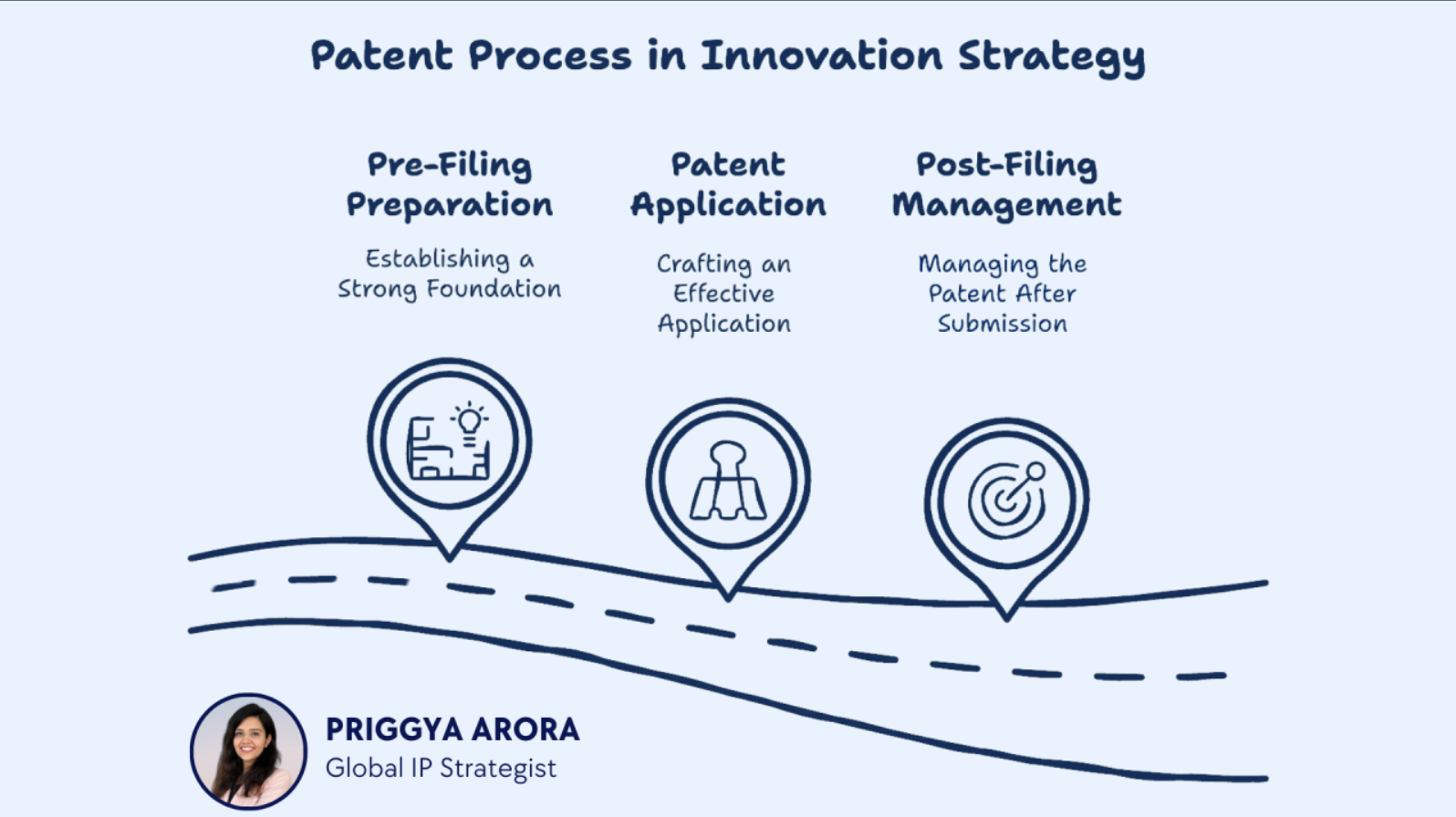
Here’s what inventors and entrepreneurs need to consider at every stage of the patent process:

1. Pre-Filing Preparation: Laying the Strong Foundation

Thorough preparation should be the focus before filing. This stage determines the success of your patent journey.

  • Conduct a Patentability Search: Ensure your invention is truly novel—research existing patents to avoid wasting time and resources on something already patented.
  • Refine Your Idea: Work on technical and commercial aspects of your invention. Ensure it solves a real problem and has market potential.
  • Create a Strong Disclosure: Document every detail of your invention. Include variations and potential applications—it’s the backbone of your patent.
  • Evaluate Business Goals: Decide how the patent aligns with your business strategy. Are you seeking to license, manufacture, or protect market share?
  • Maintain Confidentiality: Avoid publicly disclosing your invention before applying. Premature disclosure could lead to a loss of rights.

2. Filing a Patent: Crafting an Effective Application

This is where the “patent pending” status comes into play, but filing isn’t just about paperwork—it’s a strategic move.

  • Draft an Effective Patent Application: Ensure your claims are strong and comprehensive. Poorly drafted patents are vulnerable to rejection from the Patent Office.
  • File Provisional or Complete Application Strategically: A provisional application provides “patent pending” status and buys time to refine your invention, but it’s only a placeholder. A complete/ non-provisional application secures substantive rights.

3. Post-filing Management: Beyond ‘Patent Pending’

The journey doesn’t end with a “patent pending” label. To make the most of your invention, focus on what happens next.

  • Monitor the Patent Process: Track the examination process and respond promptly to office actions or objections.
  • Develop a Commercialization Plan: Identify ways to monetize your invention. This could include licensing, manufacturing, or selling the patent.
  • Expand Protection: Consider filing for international patents if your invention has global potential.
  • Enforce and Defend Your Patent: Be vigilant about potential infringements and enforce your rights when necessary.

A Comprehensive Strategy Wins the Innovation Game

Relying solely on “patent pending” status is like putting a sign on a house you haven’t fully built yet. It might look impressive, but it doesn’t provide the structural strength your invention needs in the competitive market.

A robust IP strategy spans from pre-filing research to post-grant enforcement, ensuring that your invention is not only protected but also positioned for long-term success.

So, the next time you think about a “patent pending” status, remember: it’s not the destination—it’s just a stop along the way.

What’s your approach to building an effective patent strategy? Let’s discuss in the comments!


Interested in innovation, technology and patent protection? I have a lot of insights into how technology protection works from my years in the field, and I’ll be sharing more of them on this blog.

To never miss an update, subscribe to my newsletter here.