Do you know who actually owns a patent?

Many people assume that the inventor automatically owns the rights, but that’s not always the case. There is a significant difference between the inventor, applicant, and assignee, and understanding these roles is crucial for securing and managing intellectual property.

A Real-Life Confusion in Patent Ownership

In my eight years of patent practice, I encountered a unique situation today. A person from a company (let’s call him X) reached out, explaining that he had included Person Y (from an external agency) as an inventor in a patent application. However, Person Y refused to assign rights to the company, didn’t want any commercial interest in the patent, and didn’t even want to be recognized as an inventor.

At first, this seemed unusual, but after discussing it further, we realized the issue wasn’t about ownership—it was about awareness. Person Y was simply unaware of the distinctions between an inventor, an applicant, and an assignee.

Breaking It Down: Inventor vs. Applicant vs. Assignee

To clear up confusion, here’s a simple breakdown of these three roles:

🔹 Inventor – The person who conceives the invention. They must be named in the application, but being an inventor does not automatically mean they own the patent.

🔹 Applicant – The individual or entity who files the patent. This can be the inventor, their employer, or any entity they assign their rights to. The applicant usually owns the patent unless an agreement states otherwise.

🔹 Assignee – The person or entity to whom patent rights are transferred. An inventor may be required to assign rights to their employer or another party, depending on contracts, company policies, or agreements.

In Person Y’s case, they misunderstood their role. They thought being listed as an inventor meant they had legal and financial obligations, which wasn’t necessarily true.

Key Takeaways: Avoiding Ownership Confusion

✔️ Inventors create the invention, but don’t always own it.

✔️ Applicants file and own the patent—this can be an individual, company, or other entity.

✔️ Assignees are those who receive patent rights through a formal transfer.

✔️ Employment agreements often determine whether an employee-inventor must assign rights to their company.

Understanding these distinctions ensures smooth IP management and avoids disputes. Before filing a patent, always clarify who owns what!

Have you ever faced a patent ownership dilemma? Let’s discuss 🙂

One of the biggest concerns innovators face when working on a patent project is budgeting. The costs can seem overwhelming, leading many inventors to delay or even abandon the process.

While securing a patent is an investment, it doesn’t have to be an unaffordable one. With the right strategy, you can effectively manage costs and ensure maximum protection for your invention.

Feeling Overwhelmed? You’re Not Alone.

In my experience, 80% of first-time innovatorsfeel overwhelmed by the patent process—both in terms of cost and time.

The biggest misconception? That patents require a large, one-time upfront payment. This belief often creates unnecessary stress.

However, patenting is a step-by-step journey, and each phase comes with its own costs. The key is to understand these stages and plan accordingly. Even better, your strategy can be adjusted along the way to align with your budget and business goals.

Focus on These Three Areas for a Cost-Effective Patent Process

To keep the patent process cost-effective while ensuring strong protection, follow these three key strategies:


1. Invest in a Patentability Search

Before spending money on filing fees and legal costs, determine whether your invention is truly patentable. A patentability search analyzes existing patents and prior art to assess whether your idea is novel and non-obvious.

Why this is important:

  • Reduces the risk of rejection, saving money on refiling and office actions.
  • Helps refine your invention and claims for a strongerapplication.
  • Allows you to identify potential competitors and market opportunities.

A thorough patentability search might cost a bit, but it can save thousands of dollars in the long run.

2. Draft a Strong Patent Application

Once you confirm patentability, the next step is to draft a well-structured application. A strong patent should clearly define your invention, provide well-written claims, and anticipate potential objections from patent offices.

How a strong application saves money:

  • Minimizes office actions and legal disputes, reducing future costs.
  • Speeds up the examination process, allowing faster commercialization.
  • Increases the likelihood of a successful patent grant.

A strong patent application is paramount to the innovation lifecycle, cutting corners here can lead to costly mistakes.


3. Leverage Patent Timelines and Market Strategy

One of the best ways to optimize your patent budget is to use the available timelines strategically. Patent applications don’t need to be filed in every country at once. Instead, align your filings with market research and business priorities.

Smart ways to manage filing costs:

  • Start with a provisional patentto delay full costs while securing priority.
  • Use the Patent Cooperation Treaty (PCT) to extend the timeline for international filings.
  • File in select countries where commercialization is planned, rather than anywhere where there is no market opportunities.

By timing your filings strategically, you can spread costs over several years, making the process more manageable.


Key Takeaways

Understand that patenting is a multi-step process with separate costs at each stage. The best strategy is to Spend Smart, Not More!

A strong patent doesn’t have to break the bank—it requires smart budgeting and strategic planning. If you manage costs effectively, you can secure the protection you need without financial strain.

Are you planning a patent? Let’s discuss how to optimize your IP strategy!


Interested in innovation, technology and patent protection? I have a lot of insights into how technology protection works from my years in the field, and I’ll be sharing more of them on this blog.

To never miss an update, subscribe to my newsletter here.

Tradeshows are an incredible opportunity for innovators to showcase their latest products, attract potential investors, and network with industry leaders. However, one critical mistake can jeopardize your ability to secure a patentpublicly disclosing your invention before filing a patent application.

This mistake is more common than you might think, and it can have serious consequences. If you present, sell, or even discuss the details of your invention at a tradeshow without first filing for a patent, you may lose your ability to obtain one due to novelty requirements.

Why Public Disclosure Can Make You Lose a Patent

Patent laws around the world are designed to reward novelty. This means that for an invention to be patentable, it must be new and unpublished before the filing date. When you publicly showcase your invention—whether through a tradeshow, an investor pitch, or even a social media post—you create a public disclosure that can be used as prior art against your own patent application.

In many countries, such as Europe, China, and Japan, public disclosure before filing a patent results in an immediate loss of patent rights. The United States and some other countries offer a small grace period of 12 months, allowing inventors to file a patent after public disclosure, but relying on this grace period is risky. Competitors could file their own applications based on your idea, or you may face challenges during patent prosecution.

How to Avoid This Mistake

To ensure that your innovation remains protected, take these three key steps before heading to a tradeshow:

1. File a Patent Application Before the Event

The safest way to protect your invention is to file a patent application before showcasing it publicly. If your invention is still in development, consider filing a provisional patent application first.

Provisional Patent: A cost-effectiveway to secure an early filing date while giving you 12 months to refine your invention and file a non-provisional application.

Non-Provisional Patent: If your invention is ready and fully developed, filing a complete (or non-provisional) patent application ensures stronger protection and prevents competitors from capitalizing on your idea.

2. Use NDAs for Private Conversations

If you plan to discuss your invention with investors, manufacturers, or potential business partners, ensure that they sign a Non-Disclosure Agreement (NDA).

Why?An NDA legally binds them to confidentiality, preventing them from using or sharing your invention without your permission.

Tip: Not all investors or companies agree to NDAs, so be mindful of what details you share.

3. Be Strategic About What You Disclose

Even if you have filed for a patent, be mindful of what you present at a tradeshow. Competitors may still attempt to design around your invention or file competing patents.

Share only what is necessary—highlight key benefits rather than the technical details.

Avoid publishing your invention online until you have filed a patent.

Final Thoughts

A successful tradeshow can be a turning point for your innovation, attracting potential partners and customers. But failing to protect your intellectual property before showcasing it can lead to devastating consequences, including losing your ability to patent your invention.

By filing a patent before the event, using NDAs for sensitive discussions, and carefully managing what you disclose, you can confidently present your innovation without fear of losing your rights.

If this interests you, do share your thoughts in the comments!


Interested in innovation, technology and patent protection? I have a lot of insights into how technology protection works from my years in the field, and I’ll be sharing more of them on this blog.

To never miss an update, subscribe to my newsletter here.

In my experience, many inventors come to me excited to get a “patent pending” status for their invention. Perhaps they’ve heard the term and think it’s a badge of innovation. While “patent pending” is undoubtedly valuable, it’s not a starting point—it’s a milestone on a much longer innovation journey.

A good patent strategy begins long before filing a patent and continues long after the “patent pending” status is achieved.

Here’s what inventors and entrepreneurs need to consider at every stage of the patent process:

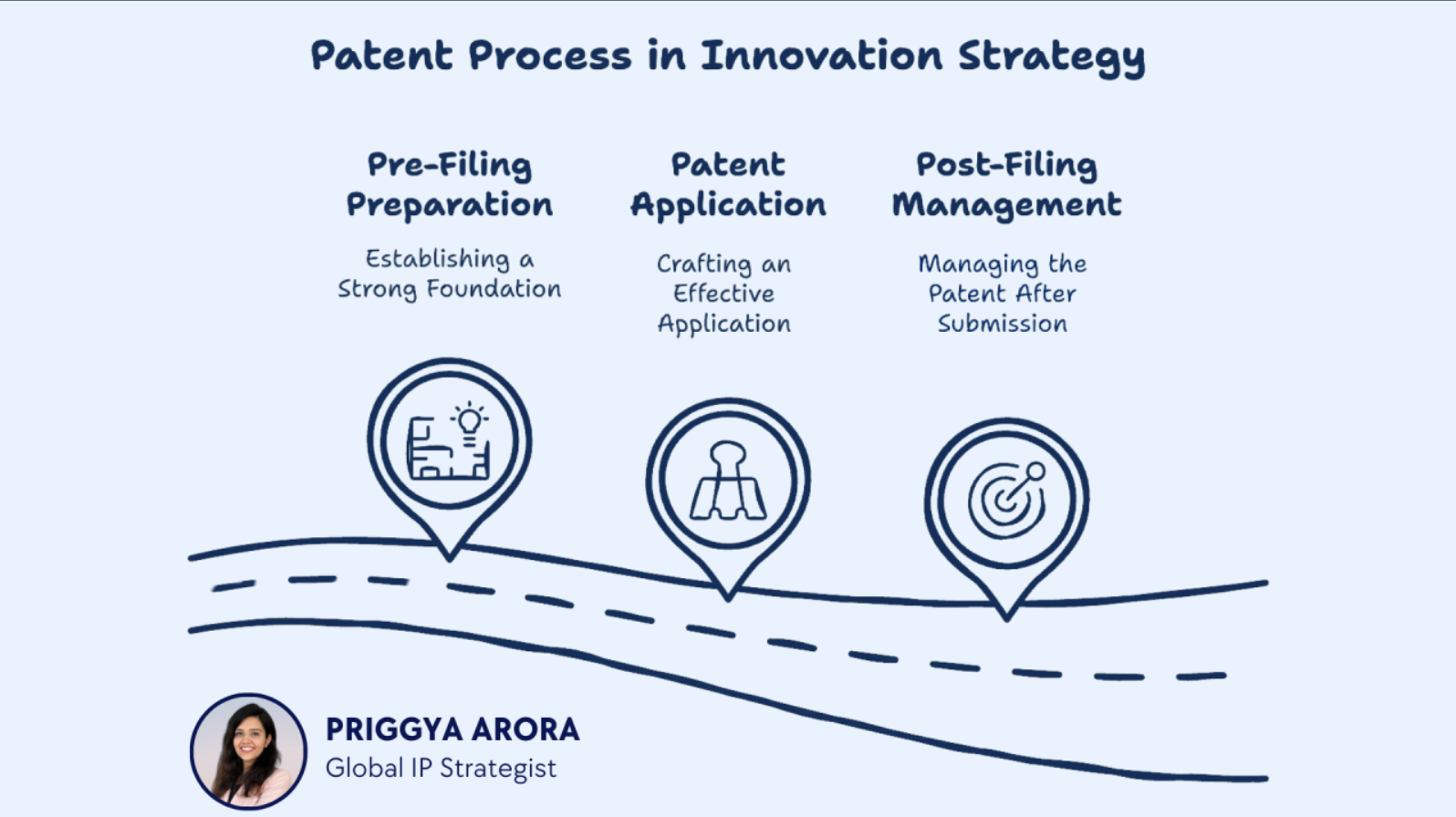
1. Pre-Filing Preparation: Laying the Strong Foundation

Thorough preparation should be the focus before filing. This stage determines the success of your patent journey.

  • Conduct a Patentability Search: Ensure your invention is truly novel—research existing patents to avoid wasting time and resources on something already patented.
  • Refine Your Idea: Work on technical and commercial aspects of your invention. Ensure it solves a real problem and has market potential.
  • Create a Strong Disclosure: Document every detail of your invention. Include variations and potential applications—it’s the backbone of your patent.
  • Evaluate Business Goals: Decide how the patent aligns with your business strategy. Are you seeking to license, manufacture, or protect market share?
  • Maintain Confidentiality: Avoid publicly disclosing your invention before applying. Premature disclosure could lead to a loss of rights.

2. Filing a Patent: Crafting an Effective Application

This is where the “patent pending” status comes into play, but filing isn’t just about paperwork—it’s a strategic move.

  • Draft an Effective Patent Application: Ensure your claims are strong and comprehensive. Poorly drafted patents are vulnerable to rejection from the Patent Office.
  • File Provisional or Complete Application Strategically: A provisional application provides “patent pending” status and buys time to refine your invention, but it’s only a placeholder. A complete/ non-provisional application secures substantive rights.

3. Post-filing Management: Beyond ‘Patent Pending’

The journey doesn’t end with a “patent pending” label. To make the most of your invention, focus on what happens next.

  • Monitor the Patent Process: Track the examination process and respond promptly to office actions or objections.
  • Develop a Commercialization Plan: Identify ways to monetize your invention. This could include licensing, manufacturing, or selling the patent.
  • Expand Protection: Consider filing for international patents if your invention has global potential.
  • Enforce and Defend Your Patent: Be vigilant about potential infringements and enforce your rights when necessary.

A Comprehensive Strategy Wins the Innovation Game

Relying solely on “patent pending” status is like putting a sign on a house you haven’t fully built yet. It might look impressive, but it doesn’t provide the structural strength your invention needs in the competitive market.

A robust IP strategy spans from pre-filing research to post-grant enforcement, ensuring that your invention is not only protected but also positioned for long-term success.

So, the next time you think about a “patent pending” status, remember: it’s not the destination—it’s just a stop along the way.

What’s your approach to building an effective patent strategy? Let’s discuss in the comments!


Interested in innovation, technology and patent protection? I have a lot of insights into how technology protection works from my years in the field, and I’ll be sharing more of them on this blog.

To never miss an update, subscribe to my newsletter here.

Take this scenario. You’ve been working on an invention and it is finally at the stage where it can be patented. You also know that a patent is very important when it comes to protecting your innovation, and that getting a patent as quickly as possible helps to head off competitors.

At this stage, your primary requirement is a well-drafted patent application. This application is what your patent hinges on. It decides if your invention fulfils all the requirements set out by the patent office, and the ambit of protection your invention gets. 

Why is a Well-Drafted Patent Application Necessary?

The rate of grants for patent applications is roughly 50%. Which is to say that one in two applications submitted to the patent office will be refused. And of course, the value of your work- all the products using the technology, or the licensing of the technology, hinge upon getting the patent protection. How well your invention is protected is directly proportional to how well your application is drafted. 

So what can you do to make sure that your patent application fulfils the requirements set out by the patent office? What must you pay attention to when reviewing it? 

Here are 5 things you must pay attention to when drafting or reviewing a patent application.

#1: The NUNS Criteria 

The first thing every potential patent applicant should keep in mind is what’s known as the NUNS criteria. NUNS stands for “Novelty, Utility, Non-Obviousness, and Subject Matter Eligibility.” 

After you submit a patent application, it gets examined by the patent office. Almost all patent applications receive objections, and all of the substantial objections are made on the basis of one of these categories. If your patent gets rejected, chances are it’s because your application did not fulfil one or more of the NUNS requirements. 

A key component of understanding the novelty and non-obviousness of your invention is the patentability search of the relevant prior art. A patentability search helps the inventor understand the current technology, and get a better understanding of the position of your invention in the potential market.

#2: The Scope of the Claims

The claims are the most important part of any patent application. The claims are a relatively short section at the end of your patent description which decide what exactly it is that you get protection on. Regardless of how detailed or sparse your patent description is, what ultimately decides on the scope of protection are your claims. 

Claims must be carefully drafted, and a fine toothed comb must be run over every single word in this section. Even misplaced articles or commas can result in the protection you get being completely different from the one you want. 

Additionally, they must neither be too broad, nor too narrow. An overly broad claim is very likely to be rejected, while a narrow claim may only protect your invention partially. A matter of a few words or a few lines can mean the difference between your application getting rejected or accepted. 

Deciding the scope of the claims must be done while keeping in mind the NUNS criteria, as well as the potential competitors in the market. Patent drafting is a multi-faceted process where the drafter is constantly looking into a number of variables, all of which must be balanced if your final draft is to be successful.  

#3: The Written Description

If your claims are what you can actually protect, your written description is the record of why and how your invention represents those claims. A claim that is not fully supported by the written description is liable to be rejected on the grounds of there being not enough information to show the application of the claims. 

The enablement requirement for patent applications is this- the examiner, representing a person of ordinary skill in the art, must be able to reliably understand and use the invention described without having to do their own undue experimentation. This element ties in with the requirement of sufficient descriptions for patent claims as well, and both must be carefully considered for a well-drafted written description.

#4: The Patent Application Format

Each patent office in the world has specific requirements for how the text and the drawings are formatted and arranged, and not following the national or regional norms will result in an objection at the examination stage. While this is relatively minor and easily corrected, especially in comparison to the other elements I’ve listed, it can still cause undue delays.

Paying close attention to and cross-checking the formatting requirements can save you a lot of trouble in the examination stage, especially if you are scrambling to come up with detailed replies to the substantive rejections.

Takeaways

Patents can be very valuable, but they are not always easy to obtain. The most important tool any innovator has to get their patent granted is the patent application. 

The application drafting process may seem pretty simple at first glance (describe your invention, and claim what you want to protect) but it can be very complex in practice. This is because of the many considerations and elements you have to simultaneously take care of to come up with an effective draft. 

What I’ve listed here are four key elements of an effective draft, and I hope that gives you a better idea of what you should be aiming at for the final application.


Interested in innovation, technology and patent protection? I have a lot of insights into how technology protection works from my years in the field, and I’ll be sharing more of them on this blog.

To never miss an update, subscribe to my newsletter here.

Imagine this scenario- you’ve been working on an invention for a while. It’s taken you a lot of effort, and the results are promising. Your efforts have resulted in something that makes life easier for people, that makes things run better and faster. 

Then you come across a stumbling block- despite all the effort you’ve put in, and despite all the usefulness of the invention, you’re unable to get a patent on it. 

What Went Wrong?

This happens more than you’d think. Innovation is the watchword of today, and plenty of people are making new and improved technology all the time. But relatively little of that technology actually makes it to the commercialization stage. Sometimes, even when the technology can be marketed, lack of adequate protection can prevent you from getting tangible monetary benefits out of your work. 

Why does this happen? How can you prevent yourself from getting into such a situation? 

After working with more than 800 innovators, business strategists, and entrepreneurs, I’ve come across three common mistakes that can cost you your patent rights.  

Mistake #1: Premature Publication

Technology is usually protected with patents, and the key aspect of any patent is in its novelty. Unfortunately, a lot of innovators and inventors do not quite understand how stringent the novelty requirements for a patent are. 

I have come across several instances of an excited academic or researcher publishing the key ideas involved in their eventual patent application, only to have it come back and work against them during the patent prosecution stage. 

The lack of novelty in an application is hard to counter, even when the inventor themselves is the person publishing the information. Many patent applications have failed on that point alone. 

If you are working on a technology with the ultimate aim of patenting, commercializing and marketing it, you need to remember that secrecy is the name of the game. 

Make sure that the only people who know what’s happening with your research are your fellow inventors and other people indispensable to your process, funding, or business strategy. Even within these exclusive circles, using non-disclosure agreements to add a further layer of protection is probably wise.  

At the end of the day, your aim should be to make sure that the first time the world hears about your invention, it’s through your patent application. 

Mistake #2: Not Doing A Patentability Search

If you are an inventor who has spent all that time, money, and effort into making your invention, chances are you want to get yourself a patent as fast as you can. This makes sense, especially since you need to make sure that nobody else patents something similar before you do it. Speed matters in the patent process.

For a lot of people, this means filing your application as soon as it’s in any kind of coherent shape. However, this means that people sometimes skip a very crucial pre-patenting process: the patentability search. 

A patentability search looks into all available literature surrounding a particular technology, and lets you know if your invention is likely to be granted a patent or not. As an added bonus, if your invention has multiple points of innovation, the patentability search can reveal which aspect to focus on so that you have a higher chance of getting a patent.  

The patent process can be long, complicated, exhausting, and expensive. If you get your twenty years of exclusive rights over technology, all that effort is worth it. If you don’t, you’ve spent a lot of resources on something that is of no practical use to you. 

The patentability search is a crucial tool that helps you avoid such a scenario, and skipping it can be very costly. 

Mistake #3: Not Having A Clear Business Strategy

In the case of any new technology, your ultimate aim is going to be commercialization. Your patent is going to be of no use to you if you cannot monetize it. 

This monetization can take many forms. The most obvious, of course, is manufacturing a product using the technology you’ve just patented. Other forms of monetization include patent licensing or patent assignments, or building up your patent portfolio so as to increase the viability and value of your enterprise.  

While the exact way of monetizing your patent is up to you, a clear business strategy for your IP is essential. As I’ve emphasized before, getting a patent is usually a lot of work. Doing that much work on something that is ultimately of no use to you is simply not practical. 

In fact, in some cases, it might actually be more beneficial to a business to never file for the patent and keep the technology a trade secret for as long as possible. Whichever way you choose, knowing exactly how your IP strategy will affect your business and marketing plans is essential. 

Takeaways

I don’t need to tell you that the technology and innovation arena is highly competitive and very fast paced. If you’re an innovator, you already know this is the case. Patents are a valuable tool you can use to protect your efforts in this field. 

However, innovators often have an improper understanding of how patents and other IPs work. Sometimes, innovators may also fail to consider how their IP protection affects their individual business needs. All of this drastically affects your chances of properly protecting your innovations. 

The three common mistakes I spoke of are only one aspect of protecting your technology, but it’s an important one.   


Interested in innovation, technology and patent protection? I have a lot of insights into how technology protection works from my years in the field, and I’ll be sharing more of them on this blog. 

To never miss an update, subscribe to my newsletter here.

Have you ever filed a patent application that got refused?

This is a very common occurrence. Generally speaking, more than half the patents filed in most jurisdictions get refused. The patent grant rate is approximately 50% in India and  52% in the USA, the numbers are not likely to be in an inventor’s favor at first glance. 

Clearly, this situation is not ideal. If you’re going through all the effort of filing and prosecuting a patent, you’d like an assurance of something tangible coming to you at the end. A granted patent allows you to monopolize a particular technology for about 20 years, which can be a massive boon to anyone working in today’s fast-moving and competitive industry. 

So, what is it that makes a patent application get rejected? With our personal experience in the field, we’ve noticed a few recurring issues.

Why Does This Happen?

The fact is, most patents get rejected because they do not, at the time of filing, fulfil the necessary conditions to get a patent. 

Every patent application must mandatorily fulfil certain basic requirements, with no exceptions. These may vary a little between jurisdictions in terms of specifics, but the general ideas are common throughout the world. 

Patent attorneys and experts make use of ‘NUNS’,  a simple mnemonic to keep track of these criteria. If your initial application has been made keeping all the NUNS requirements in mind, your application’s chances of getting granted increase exponentially. 

In fact, an application with airtight fulfilment of the NUNS criteria might even be that rare phenomenon- a patent application that is granted immediately, without any objections from the patent office.

NUNS stands for four factors, Novelty, Utility, Non-Obviousness, and Subject Matter Eligibility. 

Novelty

Novelty is the first thing you think of when you have a patent. A patent is special because the invention is new, has never been seen before, and will bring about progress (incremental or otherwise) to existing technology. If there is no novel element in your invention, there is no possibility of you getting a patent. Your invention must, at the very least, be capable of something new, or do something already known in an entirely new manner.

Utility

Utility is the simplest of the requirements in many ways. Any patent you apply for must be useful. The requirements for what counts are useful differ between jurisdictions, but it’s very rarely that they will be unmet. After all, if you are going through all the trouble of patenting your technology, it is almost certainly likely to be useful in some way or another. 

Non-Obviousness

Non-obviousness, also known as the “Inventive Step” in many countries, is usually connected to novelty. It focuses on what inventive idea the innovator had when making the subject of the patent. The basic requirement is that this idea must not be obvious to a person who is skilled in the field of that technology. 

If your inventive step is only something that surprises those who are unfamiliar with the technology, chances are your patent will face an objection and may even be rejected. This requirement is also why patent examiners are people who are skilled in the field of that technology- without such knowledge, judging this step would be impossible. 

Subject Matter Eligibility

The final requirement, subject matter eligibility, also has jurisdictional variations. In principle, it is simple- there are a number of already decided subject matters that are not granted patents by default. 

For example, pretty much all jurisdictions do not allow for the patentability of newly discovered scientific knowledge. Some, but not all jurisdictions, do not allow medical methods to be patented. The types of organisms you can patent (typically related to gene-engineering) also vary between countries and regions. 

The patentability of things like software and business methods have been debated hotly for many years at this point, and how that patentability is judged varies between jurisdictions. Some jurisdictions may have comparatively rarer restrictions, such as a ban on patenting anything that goes against “public morality”. 

Key Takeaways

Now that we know what these four requirements are, how do we actually make sure we fulfil them?

Being careful during the filing process is certainly one way of doing this, but there’s another factor that a lot of inventors miss, and that is the patentability search. 

The search concentrates on the two most difficult aspects of patentability; novelty and non-obviousness. A thorough search can give you insights on what technologies are similar to yours, and how you can construct your draft so as to focus on the actual, novel and non-obvious element you have at your disposal. 


Interested in innovation, technology and patent protection? I have a lot of insights into how technology protection works from my years in the field, and I’ll be sharing more of them on this blog.

To never miss an update, subscribe to my newsletter here!

How to get a patent granted

Ever tried to get a patent granted? If you have, you probably know how complex and long winded the process is. 

Not only do you have to delve more and more deeply into the nitty-gritties of how your invention is novel, you also need to pay attention to existing claims and the specifics of what you want to draft and what you have to disclose. 

This is not even getting into the many, many procedural requirements. Every country or organization that grants a patent has their own requirements. All of them need a very specific, individualized set of forms and formal procedures you need to complete. 

Under such circumstances, it can be difficult for any inventor, whose acumen and skills lies in the technology sector, to wrangle with legal tangles. But we’re here to help you cut through the clutter a little. 

After working with over 200 inventors, we have discovered the best way to start your patent journey. We’ve also boiled it down to five simple steps for your reference.

Step 1: Know What You Need To Do

The first mistake every innovator makes is in underestimating the time and effort that goes into getting a patent granted. The invention is merely the first step, protecting it is a whole other matter altogether.

Much like inventions themselves, patents benefit a lot from solid initial investments. A thorough and complete patentability search and expertly drafted patent specifications and claims can go a long way. 

These are the building blocks of your patent, which largely decide how strong your claim to your invention is, and they must not be neglected simply because you cannot see immediate returns on your investment.

Step 2: Do A Patentability Search

Innovations and inventions are not uncommon in today’s world, especially in the technology sector. As per the World Intellectual Property Organization, more than 3.5 million patents were filed in 2021 alone, and the number is only expected to grow.

With so many filings, it’s only natural that a lot of inventions may have overlapping elements. In fact, it is entirely possible that key elements of your invention have already been filed for protection in some form by someone else in another region. 

In such cases, establishing the all-important novelty for your invention might be hard, and all the time, money, and effort that went into your patent application may be wasted. 

A patentability search allows you to avoid this risk. Doing one gives you an overview of potentially conflicting inventions and the elements that may cause that conflict. This in turns allows you to draft the application with a focus on the elements that are actually novel, increasing your chances of getting the patent granted.  

Step 3. Identify the Key Elements in Your Invention

Novelty is one of the biggest stumbling blocks in any application. 

Your innovation is likely to have a key point that makes it uniquely novel. However, it may not be immediately obvious what that key point is, even to the actual inventor. Usually, a discussion between the inventor and a patent agent who has done a patentability search is required to tease out the actual point of novelty in any application.

Once this novelty is identified, the key innovative step must also be taken into account. The patent draft can then be written keeping these two points in mind.

Step 4. Prepare an Effective Patent Draft

The patent draft is the culmination of all your prep work. It’s where you take all the knowledge that you have gained over the past few steps so that you can make an application that stands the least chance of being rejected.

While there are provisions for making small changes to your patent draft in pretty much all jurisdictions, these changes are there only for minor issues. For example, if the examiner deems that an element you’ve already explained is insufficiently clear, the applicant can add additional information to clarify that element. 

However, you cannot bring in new material to a patent draft. Neither can you highlight a new element of novelty that was missed out on in the initial draft. 

The competence of your draft directly influences how likely it is that your invention will pass the examination stage with few or (in some very rare cases) even no objections. 

Step 5. Keep Both Legal and Technological Elements in Mind When Prosecuting Your Patent

Most patent applications are subject to initial objections from the patent office of whichever jurisdiction you decide to file them in. 

If you have followed all the steps so far, chances are you have a solid patent draft with key elements of novelty and inventive step that make your invention patentable. Now, the issue changes to how you can communicate that to the patent examiner. 

Replies to patent examinations can be written or oral. In many cases, so long as the patent draft has all the key elements that make it patentable, a written response alone may be enough to clear the objections. 

Regardless of if the response is written or not, the person authorized to represent the applicant must have a clear idea of the invention and all the steps that led to the patent application and objection. This is also why it is preferable to have one party handle the entire matter from search to prosecution of the patent, as they will have the greatest understanding of your invention with the least amount of effort on your part.


Key Takeaways


Patent filing may look like a lot of work, and that’s because it is usually the case. However, one of the most disheartening parts of the process is how it may not even be possible to get your patent granted after all of that work. 

The only way to exclude this possibility is to have a qualified patent attorney work along with you every step of the way. The attorney will know what to do and what to avoid, which parts of the invention to focus on and which ones to downplay.

Getting a patent granted may not be easy, but the steps involved in it are certainly simple. Keep these few things in mind, and you exponentially increase your chances of getting patent protection for your invention.


Interested in innovation, technology and patent protection? I have a lot of insights into how technology protection works from my years in the field, and I’ll be sharing more of them on this blog.

To never miss an update, subscribe to my newsletter here.